


1. Basic concepts: voltage, size, and power
A small DC motor converts electrical energy into rotational mechanical energy. The nominal voltage – stamped on the housing or listed in the datasheet – is the voltage at which the motor achieves its rated no‑load speed and maximum efficiency. Below that voltage, torque drops and starting may fail. Above it, insulation stress and brush arcing increase exponentially.
Physical size (diameter and length) correlates loosely with voltage. Lower voltage motors (3V to 6V) typically use thinner magnet wire and fewer turns, resulting in lower resistance and higher stall currents for a given frame size. Higher voltage motors (12V) use more turns of finer wire, increasing resistance and reducing stall current for the same torque output. This explains why a 12V motor of the same diameter as a 3V motor runs cooler under load – it draws fewer amps to produce comparable torque.
Manufacturers group small DC motor sizes into standard families. The 6‑mm diameter coreless motors (3V) power coin‑cell vibrators. The 10‑mm to 20‑mm can stack motors (6V) appear in toy gearboxes. The 20‑mm to 36‑mm series (12V) includes the widely used 130, 180, 370, and 540 frame sizes. Each family maintains a consistent mounting pattern and shaft diameter across voltage variants, allowing interchangeability.
2. Key parameters: voltage, current, torque, and speed
Four parameters define the operating envelope of any low voltage DC motor. Engineers must check these before prototyping.
No‑load speed (RPM) – Proportional to applied voltage. A motor rated 12V at 6000 RPM no‑load will run approximately 1500 RPM at 3V, but with much lower torque.
Stall torque (mNm or oz‑in) – Maximum torque at zero speed. Increases with voltage, but limited by thermal capacity.
Stall current (A) – Current drawn when the shaft is locked. For a 3V motor, stall current can be 0.5‑1.5A. For a 12V motor of similar physical size (e.g., 130 frame), stall current typically ranges 0.8‑2A; larger 540 frame motors may draw 5‑10A.
Torque constant (kT) – Torque per ampere. A 12V motor typically has a higher kT (more torque per amp) than a 3V motor of the same diameter because of additional turns.
Electrical power input: Pin = V × I
Mechanical power output: Pout = T × ω where ω is angular speed in rad/s.
Back EMF equation: V = I × R + kE × ω where kE is the back EMF constant (numerically equal to kT in SI units).
Torque‑current linear model: T = kT × (I - I0) where I0 is no‑load current.
For a given DC motor voltage range, the product of torque and speed at maximum power output is approximately one‑quarter of the stall torque times half the no‑load speed. Practical designs operate at 50‑80% of stall torque to avoid overheating.
One common mistake is ignoring the difference between nominal voltage and operating voltage under load. A 12V motor connected to a 12V lead‑acid battery sees about 12.6V when fully charged. The same motor on a 3S Li‑Po pack sees 11.1V nominal but 12.6V fresh off the charger. That small overvoltage (5%) is usually safe. But running a 6V motor on a 7.4V 2S Li‑Po (23% over) accelerates brush wear and may demagnetize cheap ferrite magnets.
3. Practical applications by voltage level
Each voltage tier serves distinct application families. Selection follows the available power source and required torque density.
3V motors

Common in disposable and ultra‑compact devices. Two alkaline cells (2.4‑3.0V) or a single lithium coin cell (3V) provide the energy. Typical miniature motor applications include:
- Electric toothbrushes (small eccentric weight on shaft)
- Handheld personal fans (10‑15mm diameter, 20‑25mm length)
- Vibration alerts in wearables and medical patches
- Micro linear actuators for camera lens positioning
These motors rarely exceed 200mA stall current and produce less than 5 g·cm of torque. Speed ranges from 8000 to 15000 RPM no‑load.
6V motors
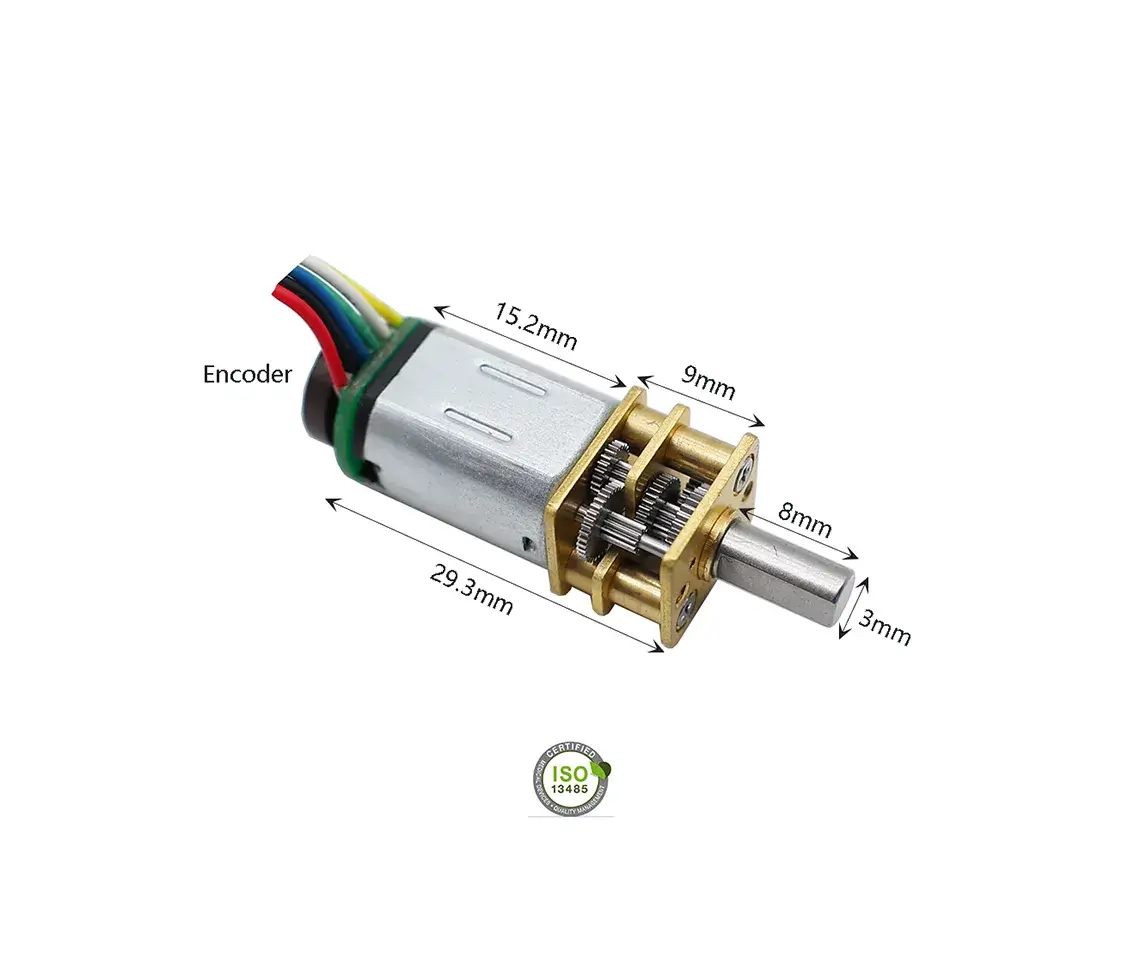
Four alkaline cells (4.8‑6.0V) or a 2S Li‑Fe (6.6V) are typical sources. These motors offer moderate torque (10‑50 g·cm) while staying cool in plastic housings. Applications include:
- Small robotic cars (N20 gearmotors with 30:1 to 100:1 reduction)
- Hobby servos (standard analog and digital types)
- Portable air pumps for blood pressure monitors
- Educational STEM kits (LEGO compatible motors)
Physical size ranges from 10mm to 20mm diameter. Many 6V motors are also rated for 7.2V (six NiMH cells) but with reduced life. For robotics‑focused gearmotor examples, see Small DC Gear Motor for Robotics Projects.
9V motors
Less common today but still found in legacy systems and some power screwdrivers. A standard 9V alkaline battery can deliver about 400‑500mA continuously, with peak currents up to 1A for short durations. Consequently, 9V motors are wound with relatively high resistance (10‑20 ohms) to avoid overloading the battery. Their niche includes:
- Replacement motors for old toy trains (HO scale locomotives)
- Miniature drills for PCB prototyping
- Electric pencil sharpeners
For new designs, most engineers bypass 9V in favor of 12V motors run at reduced voltage or 7.4V Li‑Po packs with 6V motors.
12V motors
The most versatile category for battery-powered DC motors in professional and hobby projects. Power sources include 12V sealed lead‑acid (SLA), 3S Li‑Po (11.1‑12.6V), or regulated AC adapters. Typical torque ranges from 100 g·cm to several kg·cm for gearmotor versions. Applications are extensive:
- Desktop robots (differential drive with 100‑200 rpm wheel speed)
- 3D printer filament feeders (extruder motors)
- Electric door locks and actuators (linear motion via leadscrew)
- Cooling fans for electronics enclosures (40mm to 120mm frame sizes)
- Small winches and hoists (with worm gearboxes)
- Power window mechanisms in automotive prototypes
For a deeper dive into why this voltage is the industry standard for high-performance micro-motion, explore the benefits of 12V DC motors in complex electrical applications.
Physical sizes range from 20mm diameter (130 size, see typical 130 motor) up to 36mm diameter (540 size). Stall currents vary: a 130‑size 12V motor may stall at 1‑2A, while a 540‑size motor can reach 5‑10A. Proper driving stages (MOSFETs or relays) are required for larger types.


